

With the end of federal legal protections for abortion rights in the Dobbs decision in summer 2022 and the resulting proliferation of abortion restrictions that further empower prosecutors and law enforcement to target people for their reproductive decisions, we’re going to see more and more cases of folks being criminalized for their pregnancy outcomes.
It’s extremely important that we know what’s happening across the country when it comes to pregnancy criminalization. But we also need to be exceedingly mindful about how, when, and whether we share stories of criminalization, because it’s easy to do (even more) harm, even if we don’t mean to. The abortion storytelling org We Testify has a great guide to writing about self-managed care for reporters, but the cat is extremely out of the bag on a lot of this stuff.
So let’s get into it.
I read dozens and sometimes even hundreds of stories about abortion every week for my abortion news roundups, so I wanted to tease out what I look for in stories about pregnancy criminalization, and talk about how I identify the coverage I’m most comfortable sharing with my readers. I generally take an explicitly more careful approach to sharing abortion news than a lot of other folks who write about abortion and repro rights, largely because of my experience working in repro comms with folks who defend and support people who have self-managed abortions. I appreciate good intent, but I always privilege harm reduction, and there is a lot of harm done in even the best-intentioned coverage of abortion criminalization.
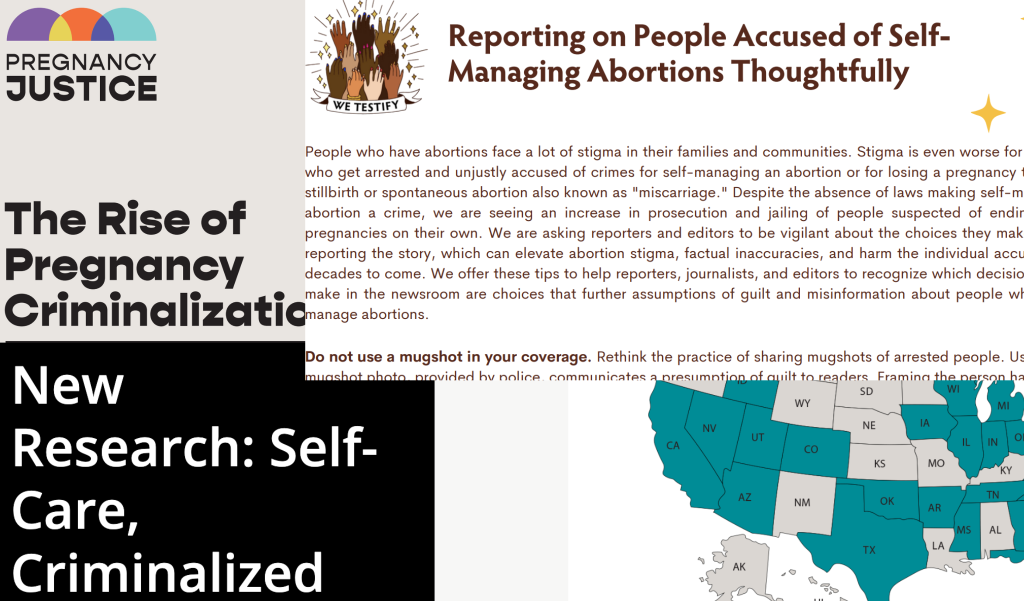
Baseline: the criminalization of pregnancy is not new, and has been an ongoing problem in the United States for decades. Motivated police and prosecutors have never needed, or waited for, letter-of-the-law abortion bans before entangling pregnant people in the court system. If/When/How, the legal organization that runs the Repro Legal Helpline and the Repro Legal Defense fund, released research on the criminalization of self-managed abortion just a couple of days ago (61 cases between 2000 and 2020!), and Pregnancy Justice, an org that supports and defends people criminalized for their abortion outcomes, also recently released a report identifying nearly 1400 cases of pregnancy-related criminalization between 2006 and 2022.
So here’s what I look for:
- Coverage that treats law enforcement as the unreliable narrators they are, and which waits for more information beyond the initial copaganda. Police and prosecutors are deeply biased sources, and I avoid linking to cop stenography whenever I can. Especially early in a story or case, it’s almost certain that police and court narratives are not just unreliable, but actively, deeply, and intentionally harmful to people who have been criminalized for their pregnancy outcomes. When writers and reporters are republishing, aggregating, or commentating on breaking stories when they are in their developing stages, it’s the reddest of red flags.
- Coverage that situates pregnancy criminalization in context. Abortion criminalization didn’t start in the summer of 2022, and isn’t reliant on ~ new ~ abortion restrictions — or, for that matter, old abortion restrictions. Pregnant people — especially low-income pregnant people, BIPOC pregnant folks, and pregnant folks who avail themselves of public services and entitlements — have had their bodies policed for decades.
- Coverage that avoids illustrations using mugshots. I can imagine what I might look like on the worst day of my life, and I wouldn’t want that photo circulated anywhere and even with people who were, at best, supposed to feel sorry for me, and at worst, going to take gleeful amusement in my worst traumas.
- Coverage that finds a way to convey essential information without using criminalized people’s full names. This one is tough, but it’s incredibly important, especially for us next-day commentators and aggregators. Daily news coverage is, by virtue of form, almost always going to name people who have been targeted by police for their pregnancy outcomes, even if only “alleged” or if they haven’t formally been charged or indicted. Allegations — to say nothing of formal charges — can still ruin people’s lives forever. We can describe charges and allegations without naming folks anew in reblogs and aggregations. I don’t want to add to the Google/search results of someone’s name for months and years after they experience pregnancy criminalization.
- Coverage that involves the affirmative and agent participation of a person criminalized, or of their legal representatives. Most court filings are public record; nothing is stopping reporters from mining the justice system for salacious details, and a lot of reporters get tipped off by anti-abortion politicians, police, and prosecutors when there’s a new case in the public record that the state is looking for coverage on, but can’t or won’t talk about openly. Because of this, I look very carefully at reporting that relies exclusively on court documents but includes no comment or input from the parties involved — and especially no comment or input from criminalized people or their attorneys.
- Coverage that does more than rehash breaking news under a different dot com. Look, I’m a bloggy blogger from the old school. I get it. We want the clicks. But “look at this horrible thing, the worst” is not a story I’ll link to unless the content adds significantly important context.
- Coverage that brings in fresh reporting. It doesn’t need to be revolutionary, but there is an already powerful and growing cohort of repro and abortion experts available to talk about abortion and pregnancy criminalization. When I read coverage that has taken the time to ask experts to weigh in, I’m vastly more likely to share it.
- Coverage that takes the legal risks around providing, supporting, and having self-managed abortions seriously. Cops and prosecutors never stop looking for ways to excuse, explain, and legitimize their investigations. Coverage that shows how people facilitate self-managed care (like photos of envelopes used to mail pills) and describes the way people transfer resources to others (like details about where and when folks travel to obtain pills) enables law enforcement to make stronger cases against the people they target.
- Coverage that starts and continues in partnership with pregnant people. There are a lot of awful stories out there these days, some of them about people who have been denied abortions, some of them about people who couldn’t access abortions, and some of them about people who experienced traumatic pregnancies and deliveries that could have been mitigated by removing the state from people’s private health care decisions. I don’t link to every story about pregnancy and abortion trauma on my newsletter — even if I think it might ~ activate ~ the average person or voter or what-have you. Which means that my readers, who I know are broadly plugged into politics, maybe miss one or two stories a week in my newsletter. That’s deliberate on my part. I don’t feel that my calling is to activate voters or ~ average Americans ~ by amplifying pregnancy trauma wherever I can find it. In fact, the more horrifying the story, the less likely I am to share it, unless I feel confident that the person at the center of that story has clearly made an agent and affirmative decision to share it.
- Coverage that privileges the knowledge, expertise, and leadership of people in the most abortion-hostile geographies. This is where most of the U.S. coastal and Beltway-based coverage will get a nope from me. I look for abortion coverage and commentary rooted in the experience and expertise of people closest to harm — most often BIPOC and women of color working in abortion funding and abortion provision in the South and the Midwest. There are great commentators on abortion who live abroad and in D.C. and on the coasts, but they don’t need me to amplify their work.
Can we always find the perfect coverage? We cannot. It’s not easy to find coverage that doesn’t use full names, includes no mugshots, doesn’t privilege cops’ narratives, asks experts for commentary, and leads with the agent and affirmative consent of pregnant people. It’s just not always available. In fact, it’s almost never available. The best I can often do is piece together the least harmful amalgamation of coverage. When I can’t find at least a triad of harm-reduction essentials, I simply don’t share the story; I know that folks will find it elsewhere that week. If a story persists over time, I’ll usually find a way to comment on it without linking to the worst examples.
Pregnant people are already facing some of the highest barriers to creating and maintaining healthy families we’ve ever seen nationwide; I don’t want to be part of making anyone’s life harder. Maybe that’s too self-aggrandizing on my part; it’s not like I’m writing the world’s most-viewed abortion blog. But I do think we should all work as hard as we can not to make pregnant people’s lives more difficult, because in this climate, it’s not a huge leap to imagine that any one of us could be the subject of the next headline.
Thanks for reading Home with the Armadillo! To get the latest posts in your inbox, subscribe below. And if you like what you read, consider dropping a few bucks in my tip jar.
And hey why not — I did a little TikTok about this if it’s easier to share with your folks:


 Home With The Armadillo
Leave a comment